



Omnia, the project coordinator, has worked over 15 years with European development projects. Omnia also participates in two of the earlier selected COVE-consortiums: GIVE and MOSAIC. Auto Cove consortium can share synergies with these two sister projects.
Omnia is the only vocational college, who educates a Vocational Qualification in Vehicle Sales, and spare parts sales. Therefore, it will develop new study modules for these Vocational Qualifications. The study module will contain objectives, raised from the skills-gap-analysis, with which future vehicle salespersons and spare parts salespersons will be able to provide factual and detailed information for customers also about clean-tech vehicles and their significance in combating climate change in Europe. The same study module will be provided to Auto-Cove partners’ co-operation companies to upskill their sales representatives with needed know-how of modern technology and greener values in vehicle field.
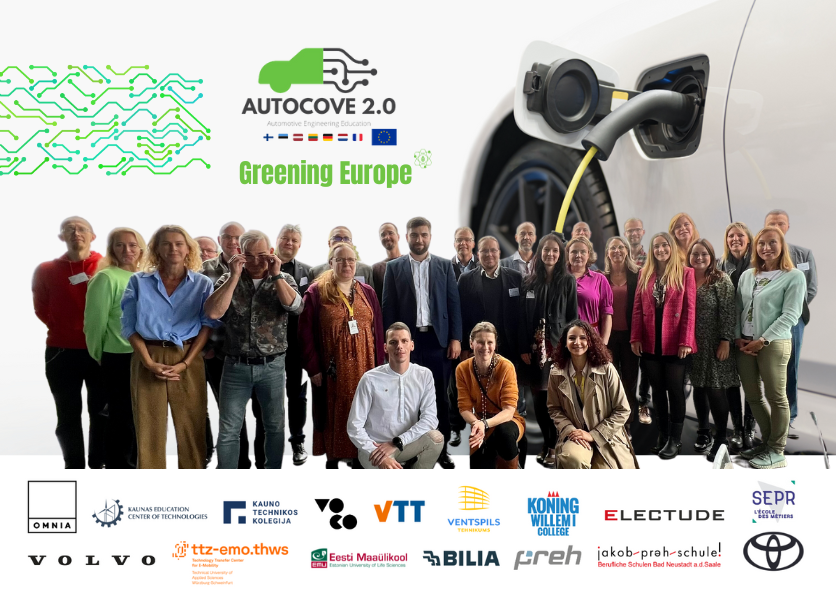
Omnia and other Finnish partners of Auto-Cove 2.0; VTT (Research centrum) + Volvo car Finland and its dealer Bilia and project’s associate partner: Metropolia; The university of Applied Sciences have co-operated already for many years on National level and in a CLEMET (Cleantech mobility Education for tomorrow)-project, which acted as a starting point for planning Auto-COVE project.
EstonianTartu Rakenduslik Kolledž has an Erasmus + mobility Charter and more than 50 partner schools in Europe. The college’s automotive technology department has close international cooperation with 20 schools in 14 countries. The department is active in one Erasmus+ KA2 cooperation projects in the field of digital learning material development and have previously completed 2 international cooperation projects. Tartu Rakenduslik Kolledž and Institute of Forestry and Engineering in Estonian Life Sciences University of Applied Sciences and Toyota Baltic also have already existing partnership in Estonia and both educational institutes are very experienced participants in international development projects. Tartu Rakenduslik Kolledž has a long-term co-operation with both Latvian Ventspils Tehnikums and Omnia.
Estonian Life Sciences University of Applied Sciences will create a pathway study module of maths and physics for Estonian technical students with Tartu Rakenduslik Kolledz. The Engine Test Laboratory at the Institute of Forestry and Engineering has the facilities and know-how to conduct vehicle and combustion engine research, development and testing. Previous projects (e.g. “Impact of biofuels on pollutant emissions from internal combustion engines 2017- 2018” T170043TIBT, Environmental Investment Centre) have been linked to research on alternative fuels and fuel additives to improve engine characteristics and reduce emissions. Participation in Auto-Cove project allows to install a mild hybrid drive to combustion engine in the Engine Test Laboratory. Laboratory staff will focus on the reverse engineering and mechanical design as well as on implementation of NCM battery pack and its telemetry to mild hybrid system. The engine could be used to develop, test and optimize various drive control algorithms. Constructed mild hybrid system can used not only by students of Tartu Rakenduslik Kolledž in the framework of training simulation car train “Hybrid and Electric vehicles”, but also by other partners of Auto Cove project.
Dutch Koning Willem I College is an experienced multi-sector VET-provider and developer of Vehicle Technology education. Their Hydrogen vehicle technology know-how would be an asset for the car mechanic education development work. They also brought their already existing company partner: Electude International with them in this project as an international specialist of digitalization of learning material in vehicle field for VET-teachers’ use. Electude will support all VET-providers in digitalizing the developed study modules with their already existing e-learning tools on a readily existing e-learning platform.
German cluster, consisting of Jakob-Preh-Schule, a technical vocational college and FHWS polytechnics + Preh-company, are also already co-operating cluster, who has a deep know-how in education development work, tight company co-operation in dual apprenticeship system and project work. Preh-company has even its own apprentice-training center and it will therefore bring substantial additional value to this project by letting other companies benchmark their way of education apprentices at the company. For instance, Volvo Finland is interested in developing a corresponding system of vehicle students’ apprentice training in their company.
French SEPR and Latvian Ventspils Tehnikums are both also educating car mechanics and have long experience of Erasmus+ project work. They will not develop a curriculum module in this project, but will pilot each module, produced by other VET-providers and take part in research 2 and share its recommendation results in Latvia and France. To be able to pilot modern technology study modules, also they will need new equipment or device to enable the piloting and testing. Ventspils Tehnikums will lead WP7 about Impact and Dissemination. Its key experts have long and wide experience specially about digital communication and social media tools. They also own wide experience at communication activities implementation. Omnia will lead the mobilities of the project. Mobilities are a big part of the project and there will be 379 mobilities in Auto Cove 2.0, which means a significant amount of work for the responsible institute in WP5.
SEPR is one of the biggest Vocational Education Centre in France and collaborates with more than 35 training centres and 100 companies all around the world, inside and even outside European boundaries. SEPR has been awarded the Erasmus+ VET charter (2015), the Erasmus+ charter for higher education (2007) and the “Good Practice” label from the Erasmus+ French National Agency (2019). French VET centre SEPR as a very experienced VET- institute of EU-projects, will lead WP6: Quality Assurance and use synergies between two Coves in their Quality work in Auto-Cove 2.0.
Lithuanian VET-centre: Kaunas Technical vocational education centre is a forerunner of vehicle education in Europe. It already acted as coordinating and applicant organisation of many of EU-projects. It is participating in the project “Inclusion and employability through electric vehicles technology” along with partners from Croatia, Italy, Portugal, Romania, and Spain. The aims of the project are improving the quality and efficiency of sustainable investment, education, training and youth systems; promoting open education and innovative practices in the digital age; promoting social inclusion; improving new technologies and digital skills. The objective of the project is to design 14 modules on electronic vehicles for students of initial VET programs in the field of auto mechanics. The modules are designed using a work-based learning methodology, animations and 3D designs that can be printed by the students in the classroom with the help of 3D printers. Another important innovation in the module will be providing the content part of each unit with a text-to-speech player integrated. They will lead WP4, Training Courses for VET-teachers and industry representatives in this project.
Lithuanian university of applied Engineering Sciences: Kauno Technikos Kolegija, as a leader in engineering studies in the Baltic region, shares actively knowledge and contributes to the advanced development of society and industry. Its main international cooperation priorities are internationalization and modernization of study programmes, introduction of innovations, realization, dissemination and multiplication of applied research results, guarantee of graduates’ competitiveness in the international labour market and development of staff competences. Kauno Technikos Kolegija will develop study modules about charging systems in Nordic conditions and about fire safety of High voltage batteries in electric vehicles in WP3.
Consortium is also enriched with 14 Associated partners: Espoon kaupunk (Finland), Kauno prekybos, pramones i amatu rumai (Lithuania), Lietuvos profesinio mokymo istaigu asociacija (Lithuania), Vilniaus automechanikos i verslo mokykla (Lithuania), Profesionalas izglitibas kompetences cents “Rigas Tehniska koledza” (Latvia), Optima samkommun (Finland), Petushallitus oph (Finland), Regierung von Unterfranken (Germany), Staatliche Berufsschule Main-Spessart (Germany), Metropolia ammattikorkeakoulu Oy (Finland), Volvo group the netherlands BV (Netherlands), Kvalifikaciju i profesinio mokymo pletros centras (Lithuania), Helsingin kaupunki (Finland), Profesionalas izglītības un kompetences centrs “Liepājas Valsts tehnikums” (Latvia).