




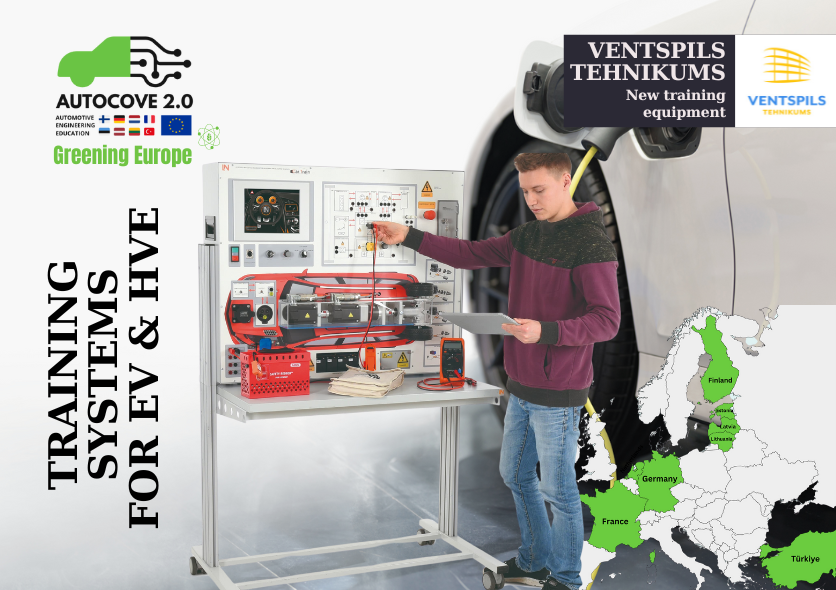
Ventspils Tehnikums, a vocational education and training (VET) school, has recently equipped itself with cutting-edge technology to offer comprehensive courses on electric and hybrid vehicles. This significant development allows students to engage with various repair and maintenance topics in a practical manner, even without having actual electric or hybrid vehicles at the school’s repair training center.
The focus on Hybrid Electric Vehicles (HEVs) and Electric Vehicles (EVs) is a central topic in modern automotive technology. These vehicles represent the innovation and driving force of the future, continuously evolving with advancements. Training and further education of specialists in this field are crucial to keep up with the rapidly changing technology. Lucas-Nuelle’s training systems serve as an essential link between industry and education, particularly in the field of hybrid and electric vehicles. These systems provide a perfect synergy of practical relevance, stringent safety requirements, and target group-oriented theory, complemented by diagnostic tasks.

The training system at Ventspils Tehnikums allows trainees to work directly on a real high-voltage (HV) system that has been specially adapted with safety features, eliminating the need for prior qualifications. This ensures a safe working environment, enabling students to concentrate fully on their tasks. The content is based on globally recognized curriculums such as DGUV 209-093, IMI EV Qualifications, and ASE L3. Trainees learn crucial theoretical concepts through an interactive e-learning curriculum, each chapter supplemented with practical tasks and knowledge questions. This combination fosters essential diagnostic skills, further enhanced by the integrated diagnostic system and carefully selected error scenarios. The training system is unique in offering trainees the opportunity to conduct various diagnostic strategies and measurements on a real HV system with real HV voltages under stringent safety conditions.
Practical Training Contents:
Servicing Work:
- Correct selection and testing of suitable instruments and equipment.
- Utilizing service information effectively.
- Performing service work on HV systems.
- Checking charging devices.
- Charging high-voltage batteries.
Repair Work:
- Measuring at potential equalization conductors.
- Disconnecting and isolating HV systems manually and with tester guidance.
- Securing against reactivation.
- Verifying isolation status (absence of voltage).
- Initiating operation of HV systems.
- Measuring insulation resistance and shielding.
- Monitoring temperatures in traction batteries and electric machines.
Diagnostics Work:
- Localizing faults in HV systems, including electric motors, inverters, and connection lines.
- Measuring equipotential bonding.
- Using diagnostic devices.
- Reading and deleting fault memory.
- Conducting measurements on the CAN bus.
The trainees at Ventspils Tehnikums gain hands-on experience with HV systems, ensuring they are well-prepared for the challenges of working with modern electric and hybrid vehicles. The training system’s design prioritizes safety, enabling students to engage in practical learning without the inherent risks typically associated with HV systems. The comprehensive curriculum ensures that trainees develop a deep understanding of both the theoretical and practical aspects of working with HV systems.
In summary, the modern technology implemented at Ventspils Tehnikums represents a significant advancement in vocational training for electric and hybrid vehicles. By providing a safe and practical learning environment, the school is preparing its students to meet the evolving demands of the automotive industry. This initiative not only enhances the students’ skills but also ensures they are ready to contribute effectively to the future of automotive technology.
#AutoCoveEUproject #GreeningEurope #VocationalExcellence #CoVE
Funded by the European Union. Views and opinions expressed are however those of the author(s) only and do not necessarily reflect those of the European Union or EACEA. Neither the European Union nor the granting authority can be held responsible for them.
Prepared by:
Auto Cove 2.0
Ventspils tehnikums