



From 26–28 April 2026, the Technical University of Applied Sciences Würzburg-Schweinfurt (THWS) participated in the annual Fahrzeugschau Elektromobilität in Bad Neustadt an der Saale, Germany. The event provided an opportunity to present innovative developments in electromobility and vocational education while engaging with industry representatives, educational institutions, and the wider public.
Bad Neustadt an der Saale has established itself as a leading regional centre for sustainable mobility and applied research. In 2010, it became the first city in Bavaria to be officially designated by the Bavarian State Government as a “Model City for Electromobility” (Modellstadt Elektromobilität). Since then, the city has fostered a strong ecosystem that connects industry, academia, and public institutions to advance research, innovation, and practical implementation in the field of electric mobility.
A key outcome of this long-standing commitment is the Fahrzeugschau Elektromobilität, which has been organised annually since 2011 and has grown into a well-established regional event attracting thousands of visitors each year. The exhibition brings together local companies, technology providers, educational institutions, public organisations, and citizens to explore current developments in electric mobility, charging infrastructure, battery technologies, and future-oriented education.
As an active contributor to this regional innovation ecosystem, THWS used the event to showcase several ongoing projects, including the Erasmus+ Centres of Vocational Excellence project AutoCove 2.0. The project demonstrates how European cooperation in vocational education can be translated into practical educational solutions that directly support local and regional development.
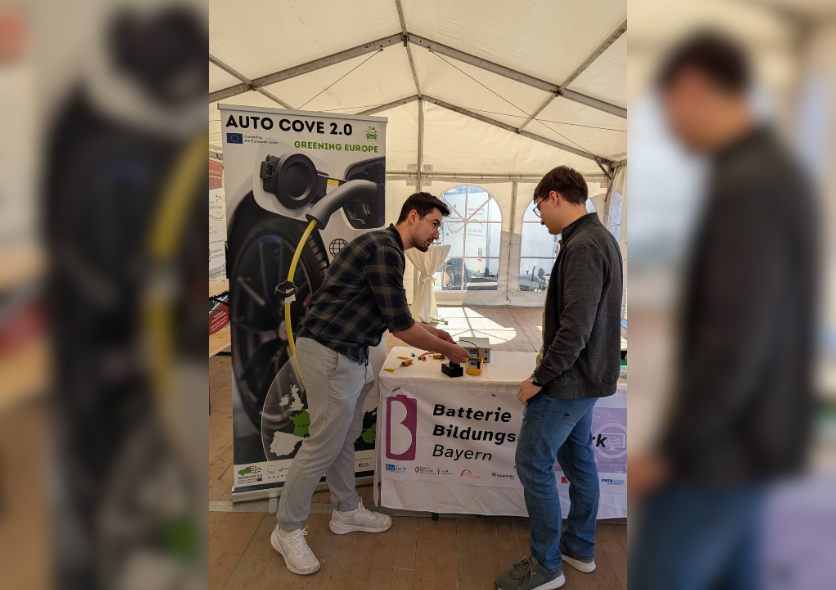
During the exhibition, THWS presented educational resources and learning concepts developed within AutoCove 2.0, highlighting innovative approaches to teaching electromobility and battery technologies. Visitors had the opportunity to explore a hands-on laboratory experiment designed to introduce fundamental principles of battery technology while demonstrating effective methods for engaging learners in technical education. The exhibit illustrated how practical learning experiences can support the development of future competencies required by the rapidly evolving automotive and energy sectors.
The participation of AutoCove 2.0 at the Fahrzeugschau Elektromobilität highlighted the strong connection between European educational initiatives and regional implementation. By bringing project results directly to students, educators, industry representatives, and the public, the event contributed to raising awareness of the skills and knowledge required for the transition towards sustainable mobility.
The experience in Bad Neustadt an der Saale demonstrated how international collaboration, applied research, and local engagement can successfully complement one another. Through projects such as AutoCove 2.0, THWS continues to support the development of innovative educational pathways that prepare learners for the challenges of future mobility while strengthening knowledge transfer between European partners and regional stakeholders.
Funded by the European Union. Views and opinions expressed are however those of the author(s) only and do not necessarily reflect those of the European Union or the European Education and Culture Executive Agency (EACEA). Neither the European Union nor EACEA can be held responsible for them.