




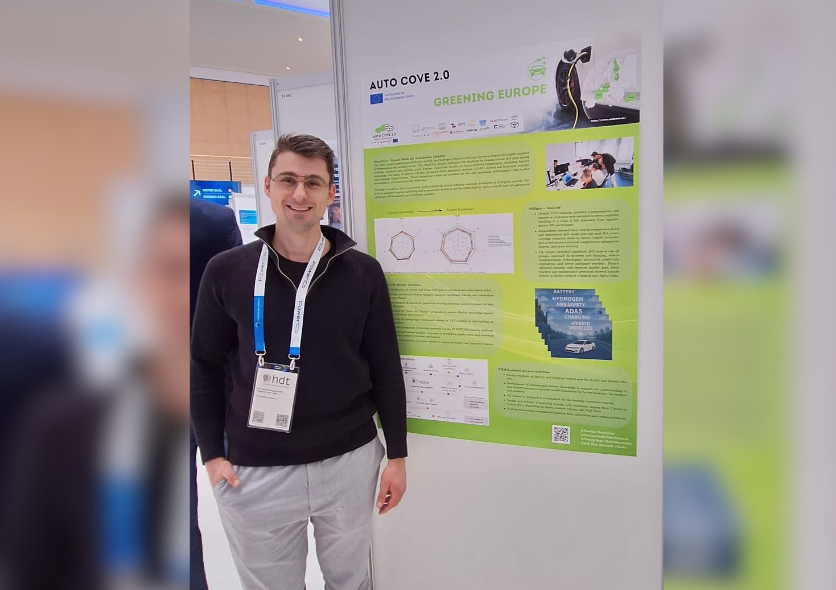
From 14–16 April 2026, representatives of the Technical University of Applied Sciences Würzburg-Schweinfurt (THWS) participated in the Advanced Battery Power Conference, one of the leading international events dedicated to battery research, development, and innovation.
The conference brought together researchers, industry experts, educators, and technology specialists from across Europe and beyond to discuss the latest developments in battery materials, performance, safety, sustainability, and future applications. Representing THWS at the event were Prof. Gunther Bohn, Sebastian Gielinger, and Sebastian Breitfelder, who actively engaged with current developments in battery technology and engineering education.
As part of the conference programme, the THWS team presented outcomes from the Erasmus+ Centres of Vocational Excellence project AutoCove 2.0. The presentation highlighted the project’s efforts to address emerging skills needs within the rapidly evolving fields of battery and hydrogen technologies.
A key focus of the presentation was the project’s comprehensive skill gap analysis, which investigated existing knowledge gaps among educators and industry professionals while identifying the competencies required for future workforce development. The findings provided an evidence-based foundation for the creation of innovative online learning materials within the Electude learning platform, ensuring that educational content directly responds to the needs of industry and vocational education providers.
Battery technology, one of THWS’s core areas of expertise, served as a practical example for demonstrating how AutoCove 2.0 supports the development of future-oriented vocational education. Conference participants were introduced to the project’s “Learning Experience Journey” concept, an educational framework designed to provide learners with a comprehensive understanding of battery systems across multiple levels of complexity.
The concept guides students through a structured learning pathway, beginning with the fundamentals of battery cell structure and functionality and progressing towards advanced topics such as battery system integration, lifecycle considerations, and second-life applications. By connecting theoretical knowledge with practical industry requirements, the Learning Experience Journey helps prepare learners for the challenges and opportunities of the rapidly growing electromobility sector.
Participation in the Advanced Battery Power Conference provided an excellent opportunity to disseminate AutoCove 2.0 results, exchange experiences with leading experts, and strengthen the connection between cutting-edge research and vocational education. The event further demonstrated the importance of international collaboration in ensuring that education and training systems remain aligned with technological developments and labour market needs.
Through initiatives such as AutoCove 2.0, THWS continues to contribute to the development of innovative educational solutions that support the transition towards sustainable mobility and advanced battery technologies across Europe.
Funded by the European Union. Views and opinions expressed are however those of the author(s) only and do not necessarily reflect those of the European Union or the European Education and Culture Executive Agency (EACEA). Neither the European Union nor EACEA can be held responsible for them.